THEISEN SLUDGE
In the pyrometallurgical process of copper slate smelting in the Mansfeld process, the dusty residues contained in the exhaust gases had to be separated from the exhaust gases by filtering and fed for further processing as the technological processes progressed.
The main amount of dust was washed out of the raw gas during the shaft furnace process by a scrubber developed by Eduard Theisen in 1904. Hence the name Theisen sludge for this residue.
From 1912 onwards, this the Theisen sludge formed the basis for the production of zinc sulphate, rhenium, thallium, germanium and cadmium (lead smelting process) in the Hettstedt lead smelter after technological treatment in rolling furnaces to form a clinker.
When the levels of lead, zinc and silver in the Theisen sludge fell due to the heavy mineralization of the copper slate, the lead smelter was closed as early as 1978. This put an end to the technological processing of the approx. 45 tons of Theisen sludge produced daily in the smelting process. The economically interesting residues from smelting had to be stockpiled or dumped.
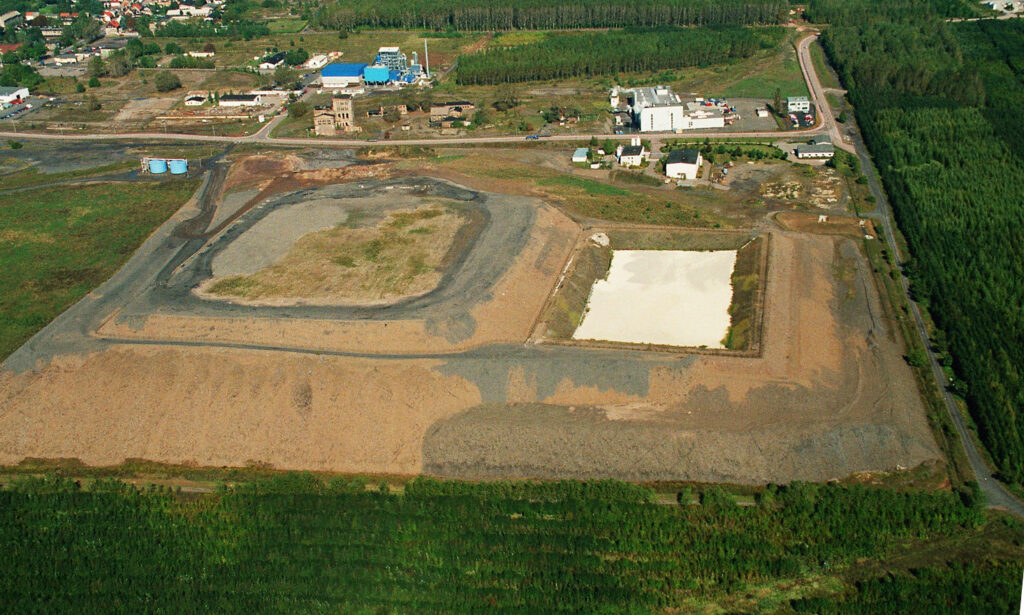
The Theisen sludge was initially stored on the lead smelter site, washed into so-called drying basins and continuously processed in the technological cycle until the smelting processes were completed. These processes were terminated in 1990, as Mansfeld copper mining was discontinued in 1990 for economic reasons, the last shift in the Sangerhausen mining district was worked on August 10, 1990 and the last shaft furnace tapping was carried out at the smelter in Helbra on September 10, 1990 - after the ore supply was completely finished.
To counteract the risk of wind transport of the temporarily stored Theisen sludge, the dry basins (approx. 40,000 m2) were covered with a fleece blanket in the fall of 1991 by GSG - Gesellschaft für Sanierung und Gesamtstrukturentwicklung Gemeinnützige Umweltsanierungsgesellschaft Mansfelder Land mbH.
On the basis of a program for the ecological protection of the Theisen Sludge, the GSG centrally stored the Theisen sludge (approx. 230,000 t) on the site of the former Helbra smelter in the "Pond 10" landfill until 1993.
A wide range of scientific studies form the basis for the necessity and possibility of processing the Theisen sludge through economic and ecological recycling and recovering the valuable metals it contains. Corresponding recommendations for action have been drawn up for politics and industry.
2023 Handbook Theisen Sludge
Handbook: Mansfeld Theisen Sludge
Author: Lutz Koch, Horst Zobel

DOWNLOAD HANDBOOK Theisen sludge (preview only)
Preview of the Handbook Theisen sludge (pages 1 and 2)